
Safety and DIY guide
How to Clean Roof Gutters (and When You Should Not)
This one is for owners who'd like to do the job themselves, and want to do it without ending up in hospital. The safest way to clean roof gutters is from the ground, with a pole scoop, a gutter vacuum or a hose attachment, and on a single storey home that often works well. When it doesn't, a ladder can be used carefully, but walking on the roof itself is where DIY should stop. Below we go through the ground-level tools, what they can't reach, ladder rules based on Victorian Government health advice, the honest answer on roof walking, how to flush downpipes and clean the outside of gutters, and whether doing it yourself actually saves money. It belongs to our set of roof and gutter guides written for Melbourne owners.
Start on the ground
Can you clean roof gutters from the ground?
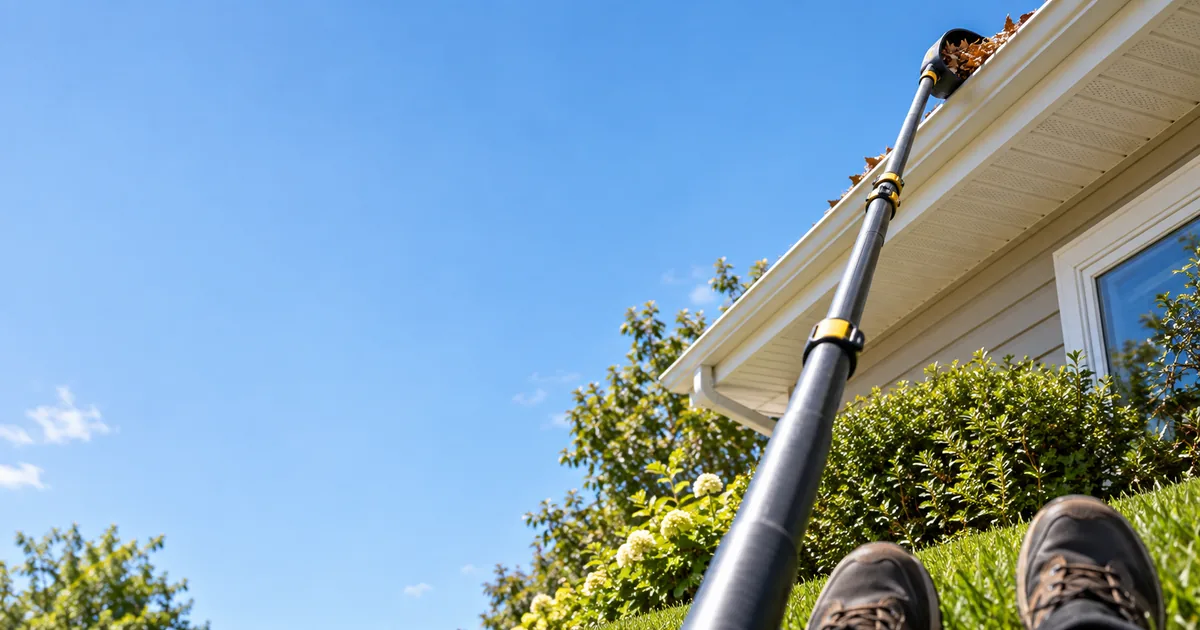
Yes, on most single storey homes. Knowing how to clean roof gutters from the ground starts with a telescopic pole: fitted with a scoop, a vacuum hose or a curved hose wand, it reaches a gutter about three metres up without anyone leaving the lawn. It works best on loose, dry leaves.
Most of the gutter-cleaning injuries we hear about start with a ladder, not a pole. Staying on the ground takes most of the risk out of the job, and for a typical Melbourne brick veneer with a single storey roofline, the gutters sit well within reach of a pole kit.
Timing makes a big difference. Dry leaves lift out easily with a scoop or get sucked up by a vacuum. The same leaves after a week of rain turn into a heavy, stuck mat that no pole tool handles well. If you can, clean after a dry spell, ideally in late autumn once the deciduous trees are bare, and again in early spring.
Work in one direction, towards a downpipe, and finish each run before moving the gear. Wear safety glasses, since anything a pole dislodges comes down towards your face, and gloves if you end up handling wet debris. Rotting leaves can carry bacteria and fungal spores, so wash your hands afterwards and cover any cuts before you start. Lay a tarp along the garden bed below so you can drag the waste away instead of raking it out of the plants.
Finish every clean the same way: run a hose into the gutter at the far end of each run and watch the water reach the downpipe and drain away. If it pools or backs up, there's still a blockage, either in a low spot of the gutter or in the downpipe itself.
No-ladder kit
Which tools reach the gutters without a ladder?
Four tools do most of the work: a pole scoop or claw for leaves, a gutter vacuum with extension tubes for fine and dry debris, a hose wand with a curved end for flushing, and a pole-mounted camera or phone to check the result. Each suits a different kind of mess.
Pole length is worth checking before you buy or hire. A single storey gutter is usually around two and a half to three metres off the ground, but a sloping block, a raised floor or a garden bed along the wall can add a metre quickly. A pole at full stretch is also much heavier to control than it feels in the shop, so pick one that reaches with some length to spare rather than one you'll be holding at its very end.
Some owners search for a gutter vacuum to hire nearby, and it's a reasonable question. Hire outlets and some tool libraries carry wet and dry vacuums with gutter kits. Before you book, check that the kit includes rigid tubes long enough for your roofline and a curved gooseneck end, since a straight tube can't reach into the gutter from below. Ask how the collected waste is emptied, too. A drum full of wet leaves is heavy.
A leaf blower with a gutter attachment is another option, but only for dry debris and only if you don't mind the neighbours' yard and your own paths getting a share of it. On a windy day it tends to blow the debris straight back onto the roof.
The honest limits
What can't you clear from the ground?
Compacted silt, anything growing in the gutter, blockages packed into downpipe outlets, box gutters behind parapets and anything on a double storey roofline. Pole tools lift what sits loose on top. Years of broken-down leaves turn into a dense sludge that needs hands, a trowel and someone at gutter height.
The bottom layer is the part people miss. Leaves break down in a wet gutter into something close to potting mix, with fine roof grit washed in from the tiles. It sticks to the gutter floor and holds water, which is where rust starts in older galvanised gutters. A scoop on a pole slides over it, and a vacuum only takes the loose top. You'll know it's there when the flush test shows water sitting in a long, shallow puddle.
Outlets and downpipe tops are the second problem. Leaves wedge into the outlet opening and get packed tight by the water pushing behind them. From the ground you can't see the outlet or get the angle to pull the plug out, and flushing hard only packs it further.
Then there's the roof shape. Valleys, where two roof slopes meet, collect a lot of debris and can't be reached from below. Box gutters behind parapets, common on inner-city terraces, are hidden entirely. Gutters above conservatories, pergolas or sloping ground may be out of reach even with a long pole. And on a double storey home, a pole gets heavy and awkward long before it reaches the gutter.
If your flush test keeps failing after a thorough ground clean, that's the point to either climb carefully or call someone in, rather than keep pushing water at a blockage you can't see.
Safety rules
What are the safety rules if you use a ladder?
Use a sound extension ladder on firm, level ground, set at a safe angle and reaching at least one metre past the gutter. Keep three points of contact, move the ladder instead of stretching, have someone hold it, and never climb in wet or windy weather.
Those figures come from the Victorian Government's Better Health Channel page on ladder safety, which also notes that older people and men make up most of the people hurt. Many of those falls happen around the home, doing exactly this kind of job. The rules below draw on that advice and on how our own crews set up.
- Check the ladder. No bent rails, loose rungs or missing feet. If it's been in the shed for years, look it over properly.
- Firm, level footing. Not soft lawn, not a garden bed, not a tiled path that's wet. Use a proper leveller on a slope.
- Set the angle. Roughly one metre out at the base for every four metres of height.
- Extend past the gutter. At least one metre above the edge you're working at, so you have something to hold.
- Three points of contact. Two feet and a hand on the ladder at all times. Use a bucket hook, not your free hand, for carrying.
- Stay low on the ladder. Don't stand above the third rung from the top of an extension ladder.
- Move, don't reach. Keep your belt buckle between the rails. Climb down and shift the ladder every metre or so.
- Have a helper. Someone at the base to hold the ladder and pass things up, and to call for help if needed.
- Pick your day. Dry, still weather only. Wet rungs and gusty wind are how most home ladder falls begin.
- Watch the power line. Keep the ladder, and any metal pole, well away from the overhead service line to the house.
Be honest about who's climbing. Better Health notes that older Australians are hospitalised after ladder falls more than any other group, and a fall that a younger person walks away from can mean a long recovery later in life. If you're in your late sixties or beyond, live alone, or take medication that affects balance, this is a job to hand to someone else or keep firmly on the ground.
Never lean a ladder against the gutter itself. Gutters aren't designed to carry that load, and older ones will bend or pull away from the fascia. Use a ladder stand-off, a bracket that rests on the roof or wall and holds the ladder clear of the gutter, which also makes it easier to reach inside.
Plain answer
Should you walk on the roof to clean the gutters?
Not on a tile roof, and not on metal unless you've been trained and have fall protection. Tiles crack under a boot and hide wet moss, and metal is slippery with dew or dust. Professionals work roofs with anchors and harnesses because the edge is so close.
Walking a tile roof damages it even when nobody falls. Concrete and terracotta tiles carry weight only where they sit on the battens beneath, and a foot in the wrong place cracks the tile or knocks the one beside it out of line. You often don't find out until the next storm sends water through the ceiling.
Metal roofs are stronger underfoot if you step along the screw lines, where the sheet sits on a purlin. They're also slippery in ways that surprise people: morning dew, a thin film of dust, pollen in spring, or the slight slope near the gutter that steepens as you approach it. On any pitched roof, the gutter edge is where you're most likely to be looking down and working, and where a slip has nowhere to stop.
WorkSafe Victoria requires businesses to control the risk of falls when people work at height, which is why a professional gutter crew uses anchors, harnesses, edge protection or a lift, depending on the job. Our about page describes how our crews set up for that. None of that gear is practical to hire for a weekend, and without it the honest answer is to stay off the roof.
The finishing jobs
How do you clean the outside of gutters and flush the downpipes?
Wash the outside of the gutter with a soft brush and mild soapy water, then rinse. Flush downpipes by running a hose into the outlet from above, and clear stubborn blockages from the bottom with a plumber's snake or a hose fitted with a jet nozzle. Never use harsh cleaners on painted gutters.
Gutter exteriors. The dark streaks on the face of many gutters, sometimes called tiger striping, come from grime and pollution that overflowing water leaves as it dries. A soft brush on a pole with mild detergent removes most of it. On painted steel, the maker's Colorbond steel care advice favours clean water and gentle methods, so skip scouring pads, solvents and pressure washers. The striping comes back faster when gutters overflow, so a clean inside keeps the outside looking better too.
Downpipes. Start at the top. Pull out any leaves sitting in the outlet, then run a hose into it and watch the bottom. A good, steady flow means it's clear. If water backs up, the blockage is usually at a bend. Try pushing the hose down from above first. If that fails, work from the bottom, either at the inspection opening if there is one or where the downpipe meets the stormwater pipe.
While you're there. A clean gutter is the best time to check its condition. Look for rust spots or pinholes along the gutter floor, joints that drip after the flush test, brackets that have pulled away from the fascia, and sections where water sits instead of running towards the outlet. A gutter needs a slight fall to drain, and older runs can sag over time. None of these are cleaning jobs, but spotting them early means a roof plumber can fix a joint or rehang a bracket before it turns into a new gutter.
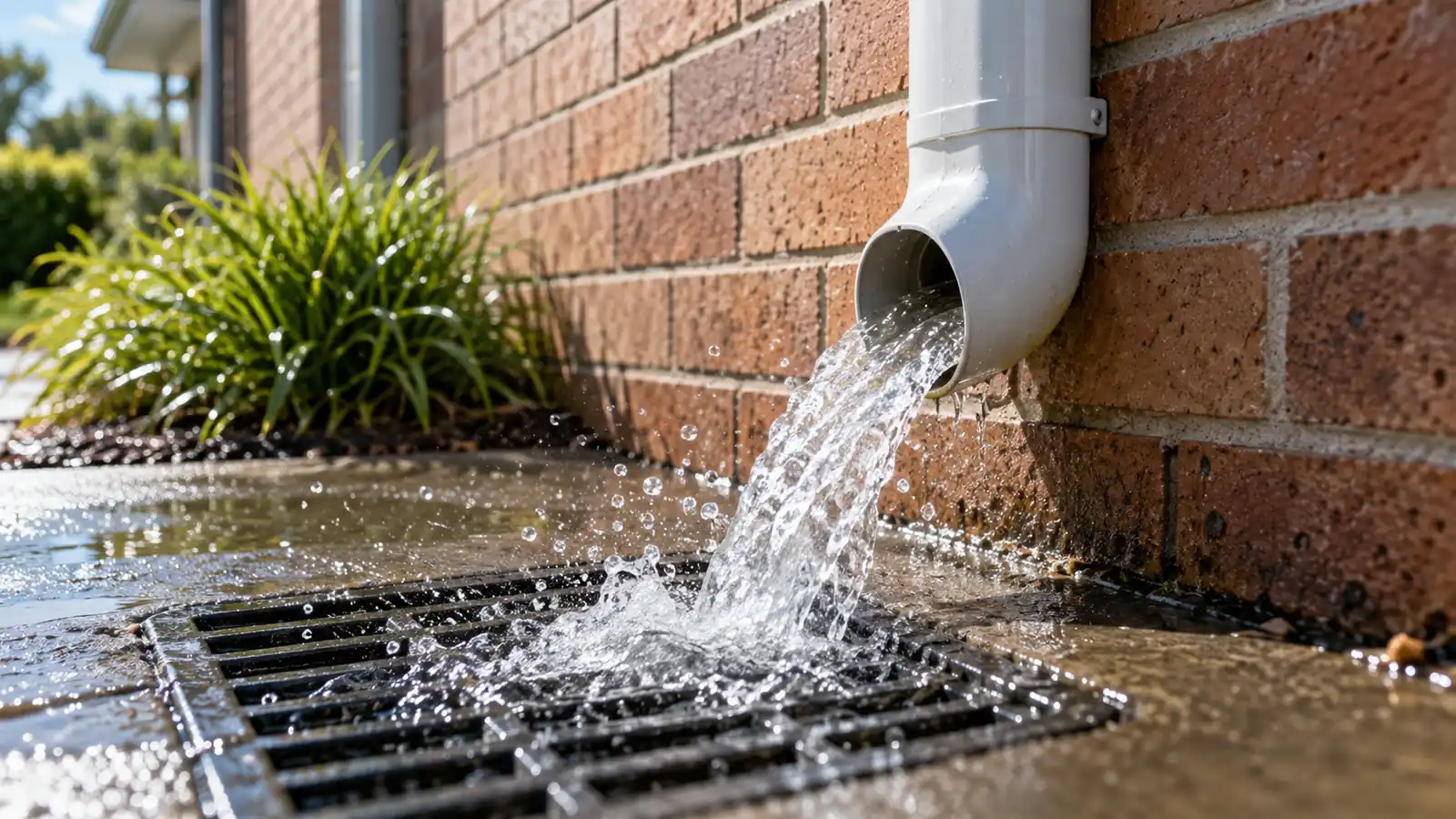
Blockages below ground, in the stormwater line itself, are a job for a licensed plumber. Signs include water bubbling out of the base of the downpipe even when the pipe above is clear, or a soggy patch of lawn along the line of the drain.
The numbers
Is doing it yourself actually cheaper?
For a low, simple home you clean once or twice a year, usually yes, once you own the gear. For a double storey home, a steep block, or gutters that need hands-on work, the saving is small and the risk is high. The fall is the cost nobody puts in the budget.
| Doing it yourself | Professional clean | |
|---|---|---|
| Upfront cost | Ladder, pole kit, gloves and glasses, or a hire fee each time | One quoted price per visit |
| Time | A morning or more, plus waste disposal | Usually a few hours, waste taken away |
| Reach | Single storey gutters from the ground or a ladder | Any height, valleys, box gutters and downpipes |
| Risk | Yours, including falls and roof damage | Carried by the operator's insurance and safety systems |
| Proof | Whatever photos you take | Before and after photos of each run |
To compare properly, get a real number for the professional side. Our Melbourne gutter cleaning cost guide sets out current market ranges by home size, and our own pricing page explains how our fixed quotes are built. If you'd rather hand the whole job over, our home gutter cleaning service covers gutters, valleys and downpipes in one visit.
A fair middle ground many owners settle on is to do the easy spring top-up themselves from the ground and book a professional for the heavy autumn clean, when the gutters are fullest and the weather makes ladders least safe.
Decided this one isn't for a ladder?
That's a sensible call on any two storey home or steep roof. Tell us where the property is and we'll quote a fixed price for the gutters, valleys and downpipes, with photos of every run when we're done.
Before you start
What else do DIYers ask about gutter cleaning?
Three questions come up more than any others from people planning to clean their own gutters: whether a ladder is needed at all, whether a tile roof can be walked on, and how hiring gear compares with paying for a clean.