
Inside the roof
Roof Cavity and Roof Space Cleaning
Roof cavity cleaning in Melbourne clears out what has been building up above your ceiling for years: fine dust, builders' offcuts, leaf litter blown in at the eaves, and the droppings and nesting left behind by rats, mice or possums. We vacuum it with HEPA-filtered machines, bag it inside the roof space and carry it out without spreading it through the house. This page is for homeowners who have just dealt with pests, are about to top up insulation, are selling, or simply want to know what is up there. Of all our roof and gutter cleaning services, it's the only one that happens under the roof rather than on top of it.
- HEPA-filtered vacuums
- Droppings bagged in the roof
- Care around wiring and ducts
What we find
What is actually in your roof cavity?
In most Melbourne homes, a roof cavity holds decades of fine dust, some leftover building material, leaves and grit blown in under the eaves, and very often signs of past animal visitors. Roof cavity cleaning removes all of that, so what sits above your ceiling is just the structure and the insulation.
- Fine dustEvery gap in the eaves and tiles lets a little in. Over thirty or forty years it settles thick on joists and ceilings.
- Builders' leftoversOffcuts of timber, plasterboard scraps, old wiring and packaging left by the original builder or later trades.
- Blown-in litterLeaves, bark and seed pods pushed in at the eaves by wind, especially under big gums.
- Animal signsRat and mouse droppings, possum latrines, chewed nesting material and bird nests near the eaves.
Older homes collect the most. A 1950s weatherboard in Preston or a Californian bungalow in Coburg may never have had anyone clear the roof space since it was built. Newer homes in growth areas like Tarneit or Clyde North usually start cleaner, but builders' offcuts and packaging are common, and rodents can move in within a few years of the first occupants.
How much it matters depends on what is up there and what you plan to do. Dust alone is mostly a nuisance for anyone working in the roof. Droppings, urine staining and nesting are a health and smell problem, and they need removing properly before anyone lays new insulation over the top.
Common reasons
When do homes book a roof space clean?
Most bookings follow one of three events: pests have just been dealt with, new insulation or ducting is about to go in, or the house is being sold or renovated. A smaller group book because of smells, dust falling from downlights or allergies they suspect start in the roof.
After rats, mice or possums
Once the pest controller or wildlife handler has done their job, the mess is still there. Droppings and urine-soaked insulation keep smelling and can draw new visitors.
Before insulation or ducting
Installers laying new batts over dust and droppings seal the problem in. A clean first means the new insulation goes onto a clean ceiling.
Selling, buying or renovating
Building inspectors look in the roof. So do renovators cutting in skylights or new downlights, and nobody wants droppings falling into a new kitchen.
Another trigger is water. When gutters or downpipes overflow repeatedly, water can find its way into the eaves and roof space, leaving damp, stained insulation and a musty smell. Fixing the cause comes first: if an overflowing downpipe is to blame, our downpipe unblocking service deals with that before the roof space is cleaned.
How we work
How does our HEPA vacuum method work?
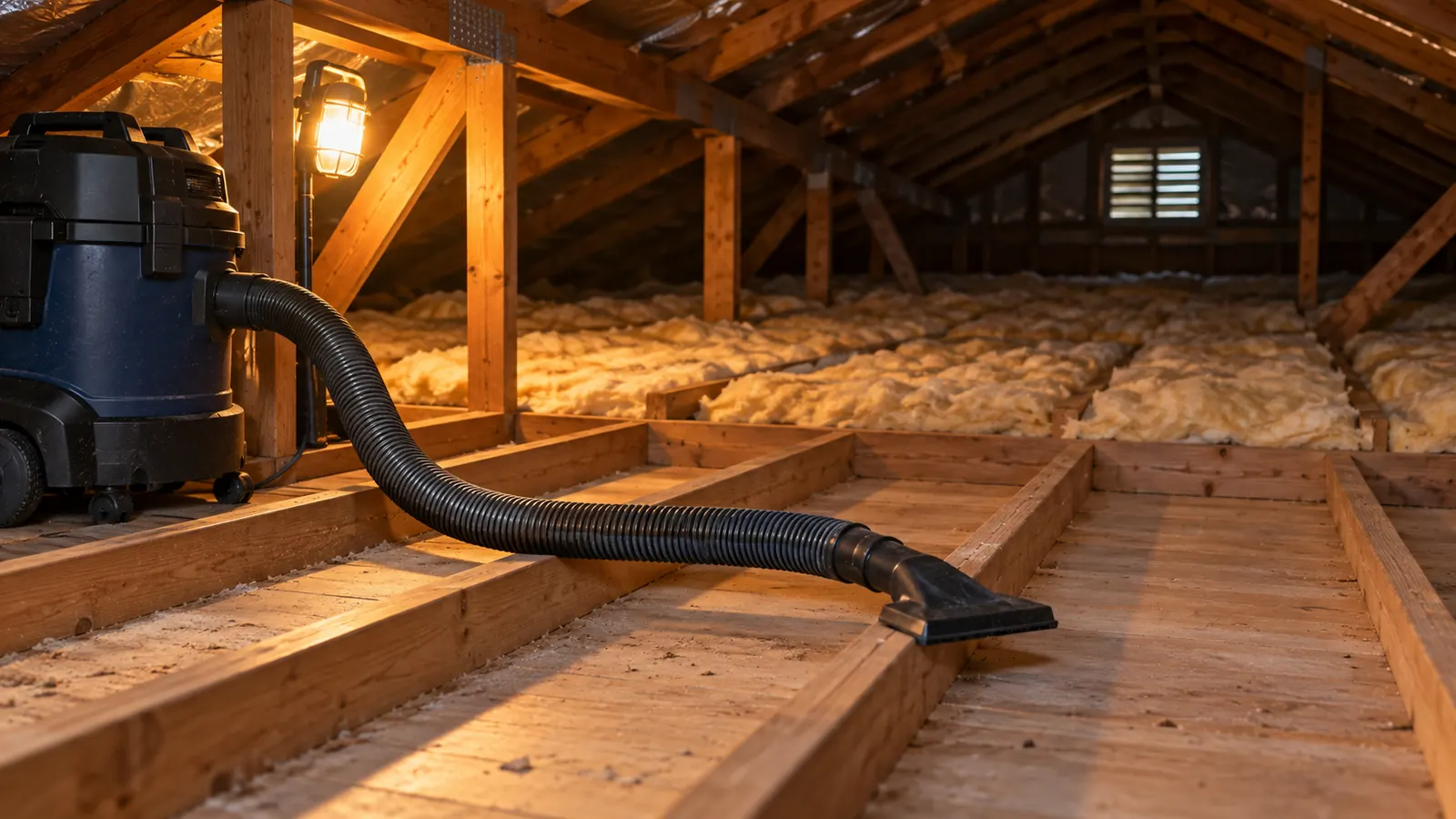
An industrial vacuum with a HEPA filter stays outside or at the manhole, and a long hose is fed into the roof space. The crew works back from the far corners towards the access hole, lifting dust, droppings and loose material off the ceiling and joists, and bagging larger debris by hand.
- Protect the houseDrop sheets go down under the manhole, the hallway is covered and the manhole surround is sealed off as much as possible.
- Check the spaceWe look for live animals, damaged wiring, suspect materials and weak ceiling areas before anyone moves across the joists.
- Vacuum from the far endWorking back towards the access means nobody crawls through a section that has already been cleaned.
- Bag and removeBulky debris is bagged and sealed in the roof, then passed down and taken straight out to the vehicle.
Crews walk only on joists, never on plasterboard, and keep hoses clear of downlights, cables and ducting. Wiring is never moved or cut; if anything looks damaged or unsafe, it is photographed and left for an electrician.
Health first
How are vermin droppings handled safely?
Carefully, with the dust kept down and the crew protected. Droppings are never swept or blown, which would lift fine particles into the air. They are vacuumed through a HEPA filter or picked up and sealed in bags, by crew wearing disposable coveralls, gloves and P2 masks.
The concern is real but specific. Better Health Channel, the Victorian Government's health information site, explains that leptospirosis spreads mainly through contact with the urine of infected animals, which in Australia include rats, mice and possums, and that breathing in aerosolised urine is one way it can be caught. That is why dry sweeping a roof space full of droppings is a bad idea, and why the work is done slowly with filtration.
| What's there | How we remove it | What happens next |
|---|---|---|
| Rat and mouse droppings | HEPA vacuum, no sweeping | Sealed in bags and removed from site |
| Possum latrine areas | Vacuumed, then soiled material bagged by hand | Stained insulation noted for replacement |
| Nests and chewed material | Bagged by hand | Entry points photographed for pest control |
| General dust | HEPA vacuum from the far end back | Ceiling and joists left clear |
| Suspected asbestos | Not touched | Work stops; you're advised to get it tested |
Houses built before about 1990 can contain asbestos in flue pipes, old lagging or offcuts of fibro left in the roof. Victoria's asbestos website lists these among common asbestos-containing materials. If we see something that might be asbestos, we stop, photograph it and leave it for a licensed assessor.
Honest scope
What do we refer to other trades?
We clean the roof space. We don't trap or remove animals, install or strip insulation, repair wiring or handle asbestos. Each of those needs a specific licence or skill, and when we find a problem in one of those areas, we photograph it and tell you who to call.
- Live rats, mice or possumsA pest controller for rodents. Possums are protected wildlife in Victoria, so a licensed wildlife controller is needed to move them on.
- InsulationAn insulation installer for new batts, top-ups or stripping out old, soiled insulation.
- Damaged or chewed wiringA licensed electrician. Rodents chew cables, and that's a fire risk worth fixing quickly.
- Possible asbestosA licensed asbestos assessor to test it, and a licensed removalist if removal is needed.
The order usually works like this: pests out first, then our clean, then any insulation or electrical work. Booked that way, each trade walks into a clean, safe space and nobody pays twice.
Pricing
What does roof cavity cleaning cost in Melbourne?
Each roof space is quoted on its own, based on the ceiling area, how easy the access hole is to work through, how much headroom there is, and what needs removing. A small, dusty cavity with good access costs least; a large, low roof space with heavy droppings and nesting costs most.
Ceiling area comes from the floor plan or aerial imagery. Headroom matters because a low-pitched roof means crawling rather than stooping, which is slower. Access matters too: a small manhole in a wardrobe takes more time than a hatch in a hallway.
The amount of mess is the other big factor. A roof space with light dust is a quick vacuum. One with years of rat droppings, a possum latrine and nesting spread across the ceiling takes far longer, because it's done slowly and bagged by hand in the worst areas.
A couple of photos taken through the manhole with a phone torch help a lot, because they show how much is up there before we quote. For how cavity work compares with gutter and roof jobs, see our roof and gutter cleaning prices.
How do I book a roof cavity clean?
Send the address, where the manhole is and a few photos of the roof space if you can safely take them. Tell us whether pests have been treated and whether insulation work is booked. We'll reply with a fixed price and a date that fits between the other trades.
Need your gutters or roof done on the same visit? Everything we cover is on the roof and gutter cleaning home page.
Roof space questions
What do people ask about cavity cleaning?
The most common questions are about safety, insulation and timing. People want to know whether droppings can be vacuumed safely, whether old batts come out, and whether a clean should happen before new insulation goes in.