
Roof care guide
How to Remove Moss From a Roof
This guide is for Melbourne homeowners looking at a green roof and wondering what to do about it. The best way to remove moss from a roof is to kill it where it grows, give it time to die and let go, then clear what's left gently. Scraping and blasting take the top off and leave the roots behind. Below we cover whether moss really needs to come off, the method step by step, what changes on tiles, terracotta, slate, Colorbond and polycarbonate, the truth about vinegar and bleach, the best months to do it here, and where a DIY job should stop. It's one of our plain-English roof and gutter guides for property owners.
First question
Should moss come off your roof?
Yes, in almost every case. Moss holds water against the roof like a sponge, it lifts the edges of tiles and slates as it thickens, and it washes into gutters and downpipes as it breaks up. A thin film is not urgent, but thick cushions are worth dealing with before they cause leaks.
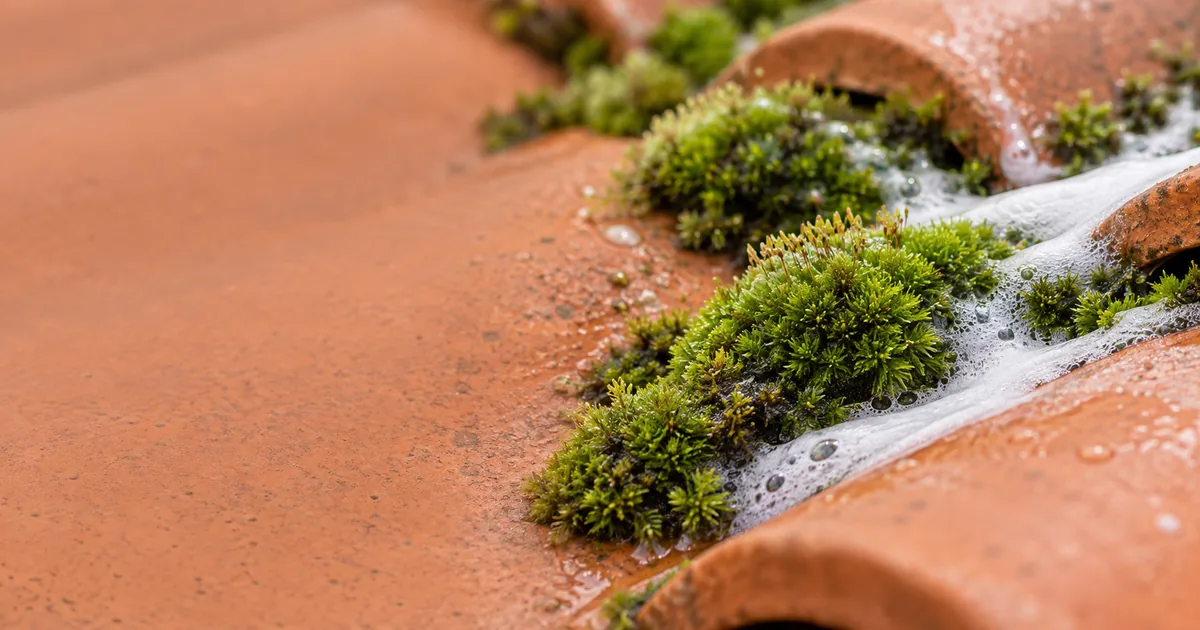
Before looking at the best way to remove moss from a roof, it helps to know what it's doing up there. Moss has no real roots. It grips with fine threads called rhizoids that work into the pores of a tile and the gaps where tiles overlap. That grip is why pulling it off by hand leaves a green stain behind, and why the same patch comes back.
The water is the main problem. A cushion of moss can stay wet for days after rain. On concrete tiles that keeps the surface damp and speeds up the loss of the surface coating. On terracotta and slate, water held at the bottom edge wicks back under the tile above, where the battens and nails sit. Over a few winters that can mean rusted nails, a slipped slate or a damp patch on a ceiling nobody can explain.
Moss also moves. When it dies back in a dry summer, it breaks into small brown clumps that roll down the roof and settle in the gutter. Those clumps are heavier than leaves when wet and they pack tight around downpipe outlets. Quite a few of the "mystery" gutter overflows we're called to in the eastern suburbs turn out to be moss from the roof above, not leaves from the trees nearby.
There are a few cases where waiting is fine. A light green tinge on the shaded side of a newer concrete roof isn't doing much harm yet. Grey lichen spots on a terracotta roof look worse than they are. If you're not sure what you're looking at, a photo taken from the ground with your phone zoomed in will usually tell you whether it's soft, raised moss or flat lichen.
Treat, wait, remove
What is the best way to remove moss from a roof?
Apply a moss treatment to the growth, leave it alone for several weeks while the moss dies and loosens its grip, then brush or rinse off what's left with low pressure. The waiting is the part people skip, and it's the part that makes the result last.
- Clear the gutters firstDead moss will come down over the following weeks, and you want the gutters empty so it has somewhere to go. If you have a rainwater tank, disconnect the inlet or divert the first flush before anything goes on the roof.
- Pick a dry, mild dayMost moss treatments need several dry hours to soak in before rain. Check the label, then check the forecast. A cool, still morning is better than a hot, windy afternoon, when the product dries on the surface before it can work.
- Apply to the growth onlyUse a low-pressure garden sprayer and wet the moss thoroughly, working from the top of each patch down. Protect garden beds, ponds and paving below by wetting them with plain water first and covering anything delicate.
- Leave it for weeks, not hoursMoss turns yellow, then brown, over the next two to six weeks. Rain during this time actually helps, washing the dead growth loose. Resist the urge to scrub it while it's still green.
- Clear what's left gentlyBrush off loose clumps with a soft broom on a pole, or rinse with a garden hose, always working down the roof so water runs with the tile overlaps and not under them. Clean the gutters again once the shedding has finished.
Two things go wrong with this method more than any other. The first is impatience: someone treats the roof, sees brown moss a week later, and scrapes it off, breaking tile edges in the process. The second is overdoing the dose, which doesn't kill moss faster but does send more chemical into the downpipes and garden. Follow the label, and if a patch is still green after six weeks, treat that patch again rather than the whole roof.
A leaf blower is handy for the final clean on a dry day, as long as you're blowing from a safe position and not standing on the tiles. A light follow-up spray can slow regrowth on shaded faces, but more sunlight on the roof does more.
By roof type
How does moss removal change by roof material?
The treat-and-wait approach works on every roof, but the clean-up doesn't. Concrete tiles handle a soft broom and a hose. Terracotta and slate should be left to weather clean. Colorbond needs nothing harsher than water and a soft brush. Polycarbonate and fibre cement should never be walked on at all.
| Roof | How much moss it grows | Gentle clean-up after treatment | Avoid |
|---|---|---|---|
| Concrete tile | A lot, especially on older, weathered tiles facing south | Soft broom from the edge, garden hose | Wire brushes, scrapers, close-range pressure |
| Terracotta | Heavy on unglazed tiles, lighter on glazed | Let rain wash it; hose rinse at most | Walking on the tiles, any scrubbing |
| Slate | Collects at the bottom edge of each slate | Rain, or a light rinse from a ladder | Standing on slate, bleach, pressure |
| Colorbond and metal | Little moss; lichen and algae in shaded spots | Fresh water and a soft brush | Abrasive pads, strong solvents, bleach |
| Polycarbonate | Algae and grime in the ribs, some moss at the edges | Mild soapy water, soft brush, from below or a ladder | Solvents, stiff brushes, putting any weight on it |
| Fibre cement (older) | Moss and lichen on the rough surface | Get it tested before anything else | Brushing, scraping or pressure of any kind |
Concrete roof tiles. These are the most common tiles in Melbourne's middle and outer suburbs and the most forgiving to work on. Once the moss has died, a soft broom and a hose do most of the work. The trap is the surface coating: on an older roof it's already thin, and scrubbing hard will strip what's left, leaving a rougher surface that grows moss faster next time.
Terracotta roof tiles. Unglazed terracotta is porous and holds water, which is why the older clay roofs of Camberwell, Malvern and Essendon go green so quickly. Old terracotta is also brittle. We'd treat it, then let the weather do the removal over a couple of months rather than trying to hurry it. Glazed terracotta grows much less and rinses clean easily.
Slate. Moss on slate gathers at the tail of each slate, where water runs off. Slates crack under a boot, and a cracked slate is a slater's job to replace. Treat from a ladder at the eaves where you can reach, and leave the rest to a crew with proper access, or to time.
Colorbond. True moss rarely takes hold on painted steel, but lichen and algae do in shaded pans and under trees. The maker's Colorbond steel maintenance advice centres on washing with clean fresh water, which is a good reason to keep bleach and scouring pads well away from it. A soft brush and a hose are enough for most metal roofs.
Polycarbonate. Pergola and carport sheeting grows algae in its ribs more than moss. Clean it with mild soapy water and a soft brush from underneath or from a ladder, and never lean or kneel on it. It isn't built to carry a person.
Fibre cement. Some older sheet roofs, particularly on sheds, garages and houses built before the 1990s, may contain asbestos. The Victorian Government's A to Z of asbestos-containing materials lists roofing among the places it turns up. If you're not sure what your roof is, don't brush, scrape or wash it until it has been checked.
Honest chemistry
Do vinegar, detergent or bleach remove roof moss?
Vinegar can kill a small patch but works slowly and wears off fast. Detergent loosens dirt but doesn't kill moss on its own. Bleach kills moss quickly, but its runoff damages plants, lawns and metal gutters and has no place near a rainwater tank. A moss treatment made for roofs is the better choice.
| Remedy | Does it kill moss? | The catch |
|---|---|---|
| White vinegar | Partly, on thin growth, with repeat applications | Weak and short-lived; it's an acid, so keep it off cement pointing and bare galvanised metal |
| Dishwashing detergent | Not really | Helps water penetrate, but the moss usually recovers; leaves a slippery film on the tiles |
| Household bleach | Yes, quickly on the surface | Burns garden beds and lawn below, corrodes metal gutters and fixings, and must never reach a tank |
| Bicarbonate of soda | On small patches only | Fine for a path, impractical across a whole roof |
| Roof moss treatment | Yes, slowly, down to the grip | Takes weeks to show results; follow the label on tanks, pets and ponds |
Searches for how to remove moss from a roof naturally mostly land on vinegar, and it's easy to see why: it's cheap, it's in the pantry, and it does turn moss brown. The trouble is strength. Household vinegar is a weak acid, and on a cushion of moss that's been growing for years, it mostly kills the top layer. The moss underneath recovers once the next few rain showers have washed the vinegar away.
Detergent gets recommended because it helps other sprays soak in. On its own it does very little to moss, and the soapy film it leaves makes tiles even more slippery. That's a real hazard for anyone who might step onto the roof afterwards.
Bleach is the one we'd talk people out of. It does work on the surface, but whatever you spray on the roof ends up in the gutters, the downpipes and the garden bed below. Chlorine is hard on metal gutters and on the plants along the drip line, and the stormwater drain carries the rest away. Victoria's Environment Protection Authority reminds households that stormwater drains run to creeks and the bay without treatment, which is worth keeping in mind with anything you put on a roof.
Timing
What is the best time of year to remove moss in Melbourne?
Early autumn and mid spring are the best windows. The moss is actively growing, so a treatment takes hold well, and there are enough dry days in a row for it to soak in. The rain that follows then helps wash the dead growth off.
Melbourne's rainfall is spread across the year rather than packed into one wet season. The Bureau of Meteorology's long-term averages for Melbourne show around 650 mm of rain a year falling on roughly a hundred days, so there's rarely a month when moss dries out completely on a shaded roof. That's why timing is about catching a run of dry days, not waiting for a dry season.
If you're planning to sell, work backwards. A treated roof takes several weeks to look clean, and listing photos taken halfway through show brown patches that look worse than the green did. Allow at least a month, and two if the growth is thick.
Safety line
Where does DIY moss removal end?
DIY stops at the point where your feet would leave the ladder for the tiles. Treating and rinsing the lower edge of a single storey roof from a well-placed ladder or the ground is reasonable for many people. Walking on wet, mossy tiles, working two storeys up, or touching slate, old terracotta or fibre cement is not.
Usually fine to do yourself
- Spraying moss on a single storey roof from the ground with an extension wand
- Treating the lower rows of tiles from a stable ladder at the eaves
- Clearing gutters before and after the treatment, from a ladder or with a pole
- Hosing off dead moss from ground level, working down the roof
Better left to someone with roof access
- Anything that means walking on tiles, slate or metal sheeting
- Double storey homes, steep pitches and sloping blocks
- Slate, old terracotta and any roof that might be fibre cement
- Moss above a glass roof, skylights, a pool or a steep drop
Moss makes a roof far more slippery than it looks from the ground, and dead moss is worse than live moss because it slides off the tile under a boot. Most roof falls we hear about didn't happen at the peak. They happened at the edge, stepping off a ladder onto a wet tile, or reaching too far to one side instead of moving the ladder.
If you do use a ladder, set it on firm, level ground, extend it well past the gutter line and keep three points of contact. Our guide on cleaning gutters safely, and when to stop covers ladder setup in detail, drawing on Victorian health advice about ladder falls. It applies just as much to moss treatment as it does to gutters.
Calling someone in
When is it worth having moss removed professionally?
When the growth is heavy, the roof is high or fragile, or you want it done once and properly. A professional crew has fall protection, knows how much each material can take, protects the garden and tank, and comes back to clear the gutters after the dead moss has come down.
The value isn't the chemical, which is broadly similar to what you can buy. It's access and judgement. A crew working with anchors and harnesses can reach the whole roof without standing where they shouldn't, and they'll know whether a cracked tile was already cracked or is about to be. That second part matters on older roofs, where a careless clean can create a repair bill larger than the job itself.
When you get quotes, ask how the moss will be removed. A good answer describes treating first and letting it die back, with only gentle cleaning after. If someone plans to scrape it off or blast it the same day, ask why. Some concrete roofs can take a carefully controlled wash as part of a full clean and reseal, and our roof pressure cleaning service explains which roofs suit it and which don't. Terracotta, slate and coated roofs are a different story.
Our roof moss removal service in Melbourne follows the same treat, wait and clear method described in this guide, with the gutters cleaned as part of the job. We'll tell you if the roof needs a roof plumber or a slater more than it needs a clean.
It's also worth asking what happens after the treatment. Dead moss keeps coming off for weeks, and most of it ends up in the gutters. A crew that clears them on the day and never comes back has done half a job. Ask whether a follow-up gutter clean or a return check is included, and whether they'll photograph any cracked tiles or loose ridge capping they find while they're up there.
Would you rather not climb up there?
Send us your address and a couple of photos of the moss taken from the ground. We'll check the roof type and pitch, tell you honestly whether it's a DIY job, and if it isn't, send a fixed quote that includes the gutters.
Common questions
What else do people ask about roof moss?
These four come up on nearly every call about a green roof: whether vinegar is enough, whether a pressure washer is a shortcut, whether the moss will return, and whether the job is safe to do yourself.