
The method
Vacuum Gutter Cleaning: How It Works
Vacuum gutter cleaning in Melbourne draws the wet leaf mat, grit and gum nuts out of your gutters through a hose on a long carbon-fibre pole and drops the lot into a drum at ground level, usually without anyone standing on the roof. It is how we clean most houses and nearly every box gutter we see, because it is cleaner, gentler on tiles and safer than working from a ladder all day. This page explains how it works, where it beats a hand scoop, where it doesn't, and whether hiring a machine yourself is worth it. It is one of the methods behind our roof and gutter cleaning services.
- Wet and dry debris
- Less time on the roof
- Nothing dropped in the garden
How it works
How does vacuum gutter cleaning work?
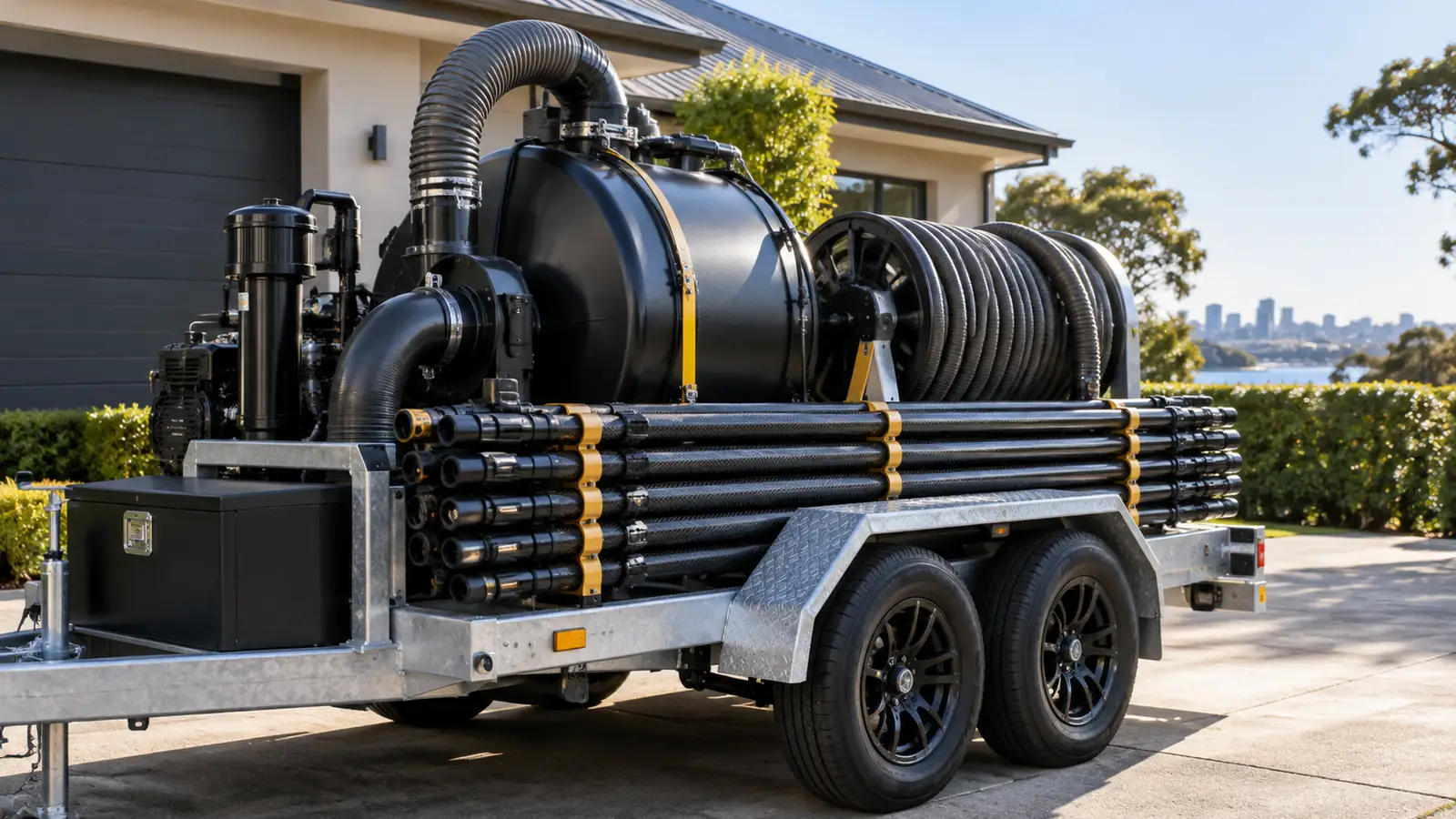
Vacuum gutter cleaning works like a giant wet and dry vacuum on a stick. A trailer or trolley unit creates strong suction, a hose runs up a set of joined carbon-fibre poles, and a curved nozzle sits inside the gutter, drawing debris back down into the drum.
The poles slot together in sections, so the operator can set the length to suit a single storey eave or a second storey gutter. The nozzle is shaped to hook over the gutter lip and sit on the bottom, where the heavy material is.
Wet leaves and silt are the reason the method exists. A hand scoop pushes a sodden leaf mat around and drips it down the wall; suction pulls it up in one piece. Dry leaves and gum nuts are even easier.
Everything collected ends up in the drum, which is emptied into sealed bags at the truck. Nothing is tipped onto the lawn, and the green bin you pay for stays empty.
Melbourne debris suits the method well. Gum nuts and bark strips are light enough to lift, plane tree leaves fold into the hose without jamming, and the fine fluff that plane seeds shed in spring, which a scoop smears into paste, comes out with the rest.
Once a run is clear, the crew photographs it, then moves on to the next. The ladder only comes out for jobs the pole can't do well, which we cover further down.
Comparison
Is vacuuming better than scooping gutters by hand?
For most gutters, yes. Vacuuming removes wet debris more completely, keeps mess off walls and gardens, and cuts the time spent on ladders and roof tiles. Hand scooping still has a place for compacted silt and stubborn outlets, which is why good crews use both.
| Factor | Vacuum and poles | Hand scoop from a ladder |
|---|---|---|
| Wet leaf mats | Lifted out in one go | Break up and drip down walls |
| Mess below | Contained in the drum | Usually dropped or tipped on the ground |
| Time on a ladder | Mostly none from the ground | The whole job, moved every metre or two |
| Walking on tiles | Rarely needed | Often, to reach back runs and valleys |
| Compacted silt | Needs help from a scraper or trowel | Good, with effort |
| Checking the result | Photographed as each run is finished | Depends on the ladder position |
There is one more difference people notice: noise. A vacuum unit is louder than a person with a bucket, a bit like a leaf blower for the time it runs. On most homes that is a morning at most. On schools, clinics and offices we plan around it, starting early or working in stages so meetings and classes aren't interrupted.
That combination is what makes it our default on houses. The house gutter cleaning page explains what else a home visit includes, from valleys to downpipe tops.
Awkward access
Which hard-to-reach gutters suit a pole vacuum?
Poles earn their keep wherever a ladder is risky or impossible to set up: above glass roofs and pergolas, behind pool fences, over steep garden beds, along narrow side paths and on second storey runs above a lower roof. The crew stays on firm ground and the nozzle does the reaching.
- Second storey above a lower roofThe upper gutter overhangs a garage or extension, so a ladder would stand on the lower roof. The pole reaches over it.
- Glass roofs, pergolas and verandahsNo safe place for ladder feet, and nothing you want a heavy boot on. The nozzle works over the top.
- Pools and pool fencesLadders can't go near the water or lean on glass panels. The operator works from the path.
- Sloping blocks and terraced gardensCommon in the hilly east and around the Dandenongs. Ladders on a slope are one of the riskiest setups in the trade.
- Narrow side pathsTownhouses and older terraces often leave less than a metre between walls, too tight to angle a ladder safely.
- Slate and brittle tilesOld roofs in Kew, Hawthorn and Brighton that crack underfoot. Keeping everyone off the roof protects it.
The same approach scales up on warehouses and schools, where long box gutters are cleared from the roof edge or a lift. The commercial gutter service covers how that works on bigger roofs.
Honest limits
When is hand clearing still needed?
Hand work is still needed wherever debris has set hard or grown roots. Silt that has baked into a crust, grass and seedlings living in the gutter, and outlets packed with bark all need a scoop, a trowel or fingers before the vacuum can finish the job.
- Baked silt. After a dry summer, the bottom layer can set like clay. It is broken up by hand, then vacuumed.
- Living plants. Grass and weed roots bind the whole gutter. They are pulled out first.
- Outlets and pops. The mouth of the downpipe is always checked by hand, whatever the nozzle has done.
- Deep valleys. Some valleys need a person up close to clear the wedge of leaves under the tile edges.
Box gutters on commercial roofs follow the same rule. Their wide, flat bottoms collect a layer of fine sludge that the nozzle lifts easily, but sump guards and corners are still cleaned by hand.
Anyone who promises a vacuum-only clean on a neglected gutter is either leaving the bottom layer behind or hasn't seen the gutter yet. The price you're quoted already allows for the hand work your roof needs.

Doing it yourself
Should you hire a gutter vacuum and do it yourself?
On a single storey house with dry leaves, a hired vacuum kit can work. On anything taller, wetter or steeper, the saving shrinks fast once you count the hire cost, the time it takes to learn the poles and the ladder work you still end up doing.
Price it out honestly before you decide. Add the day's hire, the trip to collect and return the machine, a tip run for the waste and a full weekend day, then compare that with a quote. On a two-storey home, the ladder work alone usually settles it.
WorkSafe Victoria's compliance code on preventing falls is written for workplaces, not homeowners, but it is a good guide to how professionals think about ladders: use them last, and only when nothing safer will do. If you do want to have a go on a low roof, read our step-by-step DIY gutter guide first; it explains which jobs are sensible to tackle and which to leave.
Pricing
Does vacuum gutter cleaning cost more?
No, not with us. Vacuuming is simply how most of our gutter cleans are done, so it isn't a separate charge or an upgrade. The price is set by the building: storeys, gutter length, how full the gutters are and how easy the ground is to work from.
Because the vacuum is faster on wet debris and needs fewer ladder moves, it often keeps the time on site down, which helps keep quotes steady. Where a roof needs extra hand work, such as baked silt or plants growing in the gutter, that shows up in the quote before you book, not on the invoice after. For a fuller picture of what goes into gutter and roof cleaning prices, see the pricing page.
One practical tip: if your gutters were last cleaned years ago, say so in the quote request. A gutter packed solid takes longer than one cleaned last autumn, and knowing that in advance means the price we give you is the price you pay.
How do I book a clean using the vacuum method?
Request a quote with your address, the number of storeys and any awkward spots like pools, glass roofs or steep gardens. We check the roof on aerial imagery, confirm the pole length and access plan, and reply with a fixed price and the next available dates.
Want the full picture of what we clean? See the Melbourne roof and gutter cleaning homepage.
Method questions
What do people ask about the vacuum method?
Most questions about the vacuum method come down to three worries: whether it copes with soggy leaves, how you can tell the gutter is really clean, and whether the method costs extra. Here are the short answers.